BULBUL AND NAZRUL TECHNICAL SERVICES is an independent repair company. We are not an authorized service agent of, and are not affiliated with or endorsed by, Gaggenau. The name “Gaggenau” and all other manufacturer names and model references on this page are trademarks of their respective owners and are used only to identify the equipment we service.
Our Starting Prices
Our own rates, set and verified by our technical team — not estimates. Published up front so you can compare before you call. All prices exclude 5% VAT.
| Service | Starting price (AED) |
|---|---|
| On-site diagnosis / call-out Waived when you approve the repair | 125 |
| Refrigerator — thermostat / sensor | from 350 |
| Refrigerator — gas recharge | from 500 |
| Dishwasher — inlet valve / drain pump | from 325 |
| Oven / cooking range — element or thermostat | from 275 |
Final price confirmed on site after diagnosis. No work starts without your approval.
- VAT — all prices exclude 5% VAT.
- Spare parts — quoted separately and approved before work begins. We use OEM parts where available, and disclose high-grade equivalents before fitting.
- Warranty — 90 days on parts and labour. See our warranty terms.
- Payment — cash, card or bank transfer.
Booking an independent Gaggenau repair
We are a licensed UAE repair company working across Dubai, Sharjah, Abu Dhabi and Ajman, 24 hours a day. Every repair carries a 90-day warranty on parts and labour, and the call-out is waived when you approve the work. If your appliance is still under Gaggenau warranty, use Gaggenau's own service channel first — an independent repair may affect that cover.
Which Gaggenau appliances we repair
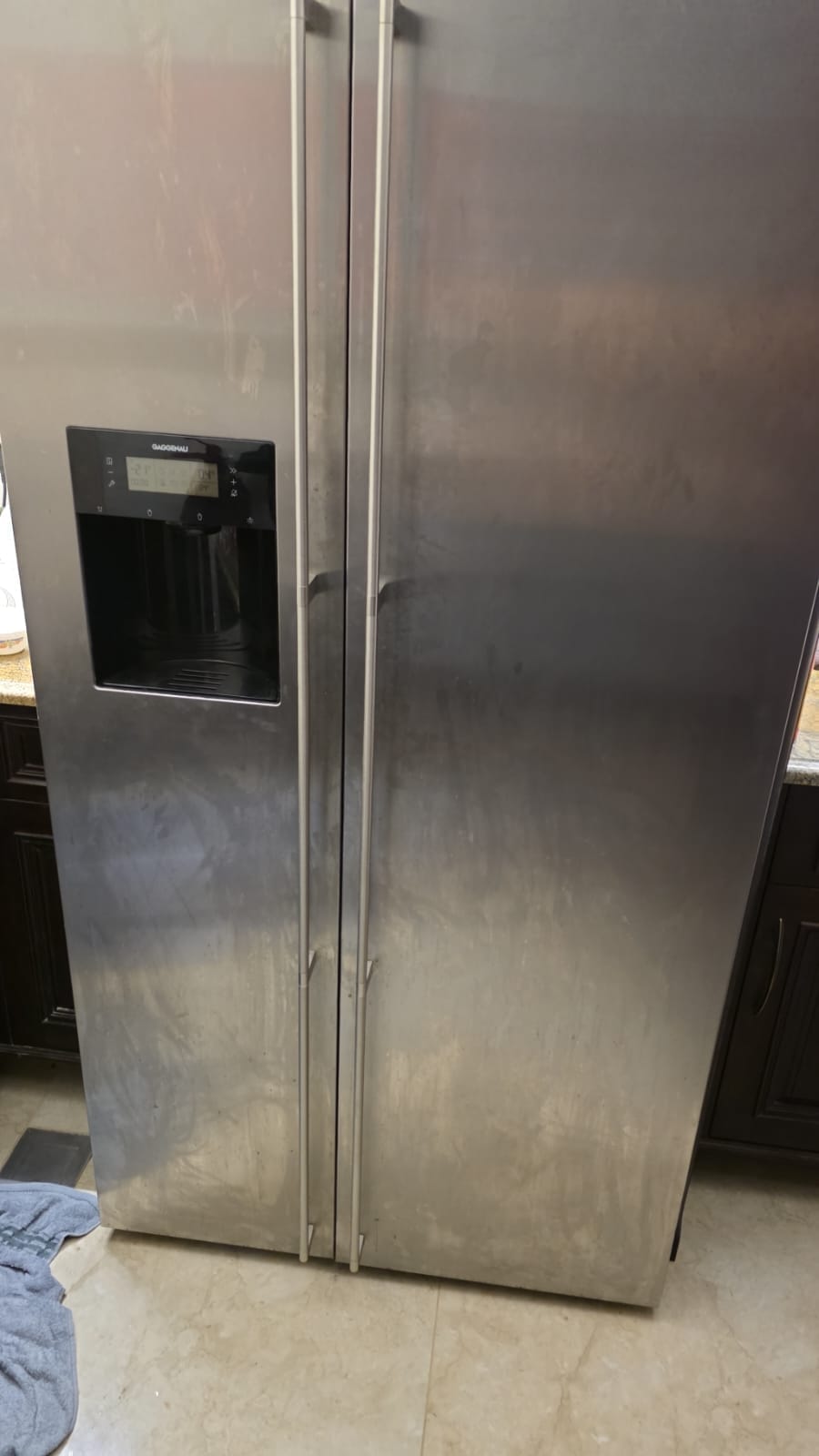
We service Gaggenau built-in ovens, steam ovens, hobs, wine cabinets, refrigerators, freezers and dishwashers. Every fault is tested and confirmed before any part is replaced, and you approve the price before work starts.
Common Gaggenau fault codes and what they actually mean
These are codes we are called out for on Gaggenau appliances in the UAE. A code narrows the search — it does not name the broken part on its own, which is why every job starts with a test rather than a guess.
E003 / E303 / E115 / E215 — steam oven / combi-steam oven
Thermal-protection group on Gaggenau steam / combi-steam ovens (verified on BS 250/251/254/255). The appliance has registered that it is too hot and will not heat - Gaggenau's wording is 'the appliance is too hot', shown when 'the appliance does not heat up'. The documented remedy is the whole of it: switch the appliance off and let it cool down. Gaggenau gives no instruction for a code that returns once the oven is cold, so if we say a repeat points to restricted cooling or a misreading sensor, that must be framed as our engineers' experience, not as the manual's advice. Note also that the manual sends you to after-sales service for any error code OTHER than these four.
Usually: Most often blocked or obstructed ventilation openings in the cabinet housing, or a tangential cooling fan that has slowed or stopped. Also seen with a failing cavity temperature sensor reading high, or a unit installed into a housing with inadequate airflow. In UAE kitchens, fine dust build-up in the cooling path and high ambient kitchen temperature make this a more frequent call than in cooler climates.
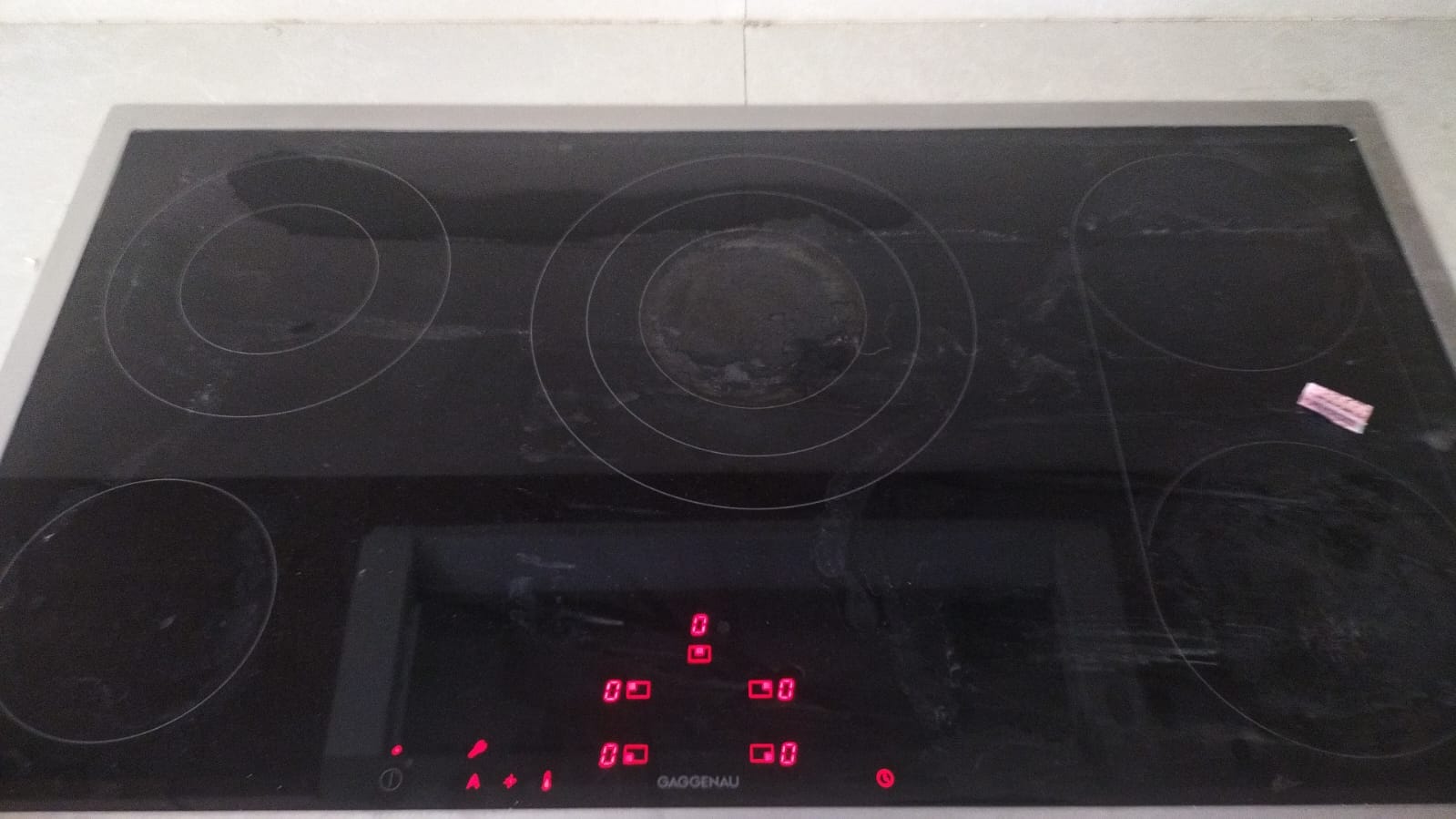
F2 / F4 — induction hob (cooktop)
Verified on the Gaggenau CI 261 induction hob. The power electronics under the glass have overheated, and one or all of the cooking zones have been switched off as a result. Gaggenau's table groups F2 and F4 with E7015, E8207 and E8208 - all five share this cause and remedy. This is thermal self-protection, not a defective board: wait until the electronics have cooled down sufficiently, then touch any button on the control panel and cooking resumes. Say 'the electronics have overheated', not 'the board has failed'. To read the code at all, press and hold the sensor for the affected cooking zone.
Usually: Restricted airflow to the underside of the hob is the usual culprit - a drawer, a solid shelf, or an oven fitted directly beneath without the specified clearance. Also caused by a clogged or failed cooling fan, or by running several zones at high power for a long session in an already hot kitchen. On the same line Gaggenau also prints E7015, E8207 and E8208; those E-numbers are rendered in a stylised seven-segment typeface in the PDF so treat the exact digits as indicative rather than definitive.
F1 / F6 — induction hob (cooktop)
Verified on the Gaggenau CI 261 induction hob. One cooking zone has overheated and has been switched off on its own. Gaggenau's stated purpose is to protect the work surface - the wording is the manual's and it is what distinguishes this pair from the F2/F4 electronics-overheat group. Wait until the electronics have cooled down sufficiently, then switch the cooking zone back on. Any explanation about heat reaching the surrounding worktop is our interpretation of 'work surface', not a Gaggenau statement.
Usually: Typically an empty or nearly-dry pan left on a zone at high power, a badly warped or thin pan base making poor contact, or repeated high-power use with no cool-down between. Can also point at a zone temperature sensor that has drifted and is tripping the cut-out too early.
F5 — induction hob (cooktop)
Verified on the Gaggenau CI 261 induction hob. Hot cookware is sitting too close to the control panel and is heating the panel electronics. Gaggenau documents two behaviours. With F5 shown alongside a power level and an audible signal it is a warning only: remove the cookware, the fault display goes out shortly afterwards, and you can carry on cooking. With F5 and a signal tone alone, the cooking zone has already been switched off to protect the electronics: remove the cookware, wait a few seconds, then touch any button - only when the fault display goes out can you continue. Do not say the display clears itself in both cases; the second case needs a button press.
Usually: Almost always a pan, kettle or hot tray parked on or overhanging the front control strip. Not usually a component failure at all - but if F5 appears with nothing near the panel, the panel sensor or the ribbon connection behind the glass is worth checking.
F8 — induction hob (cooktop)
Verified on the Gaggenau CI 261 induction hob. The individual safety switch-off has operated: a cooking zone has been running continuously for an extended period without any change of setting, so the hob has switched it off. The permitted period is not a single figure - it scales with the power level, from 10 hours at levels 1.0-1.5 down to 1 hour at levels 8.0-9.0. Touch any button to clear the display and the zone can be set again. This is designed behaviour, not a fault, though customers routinely report it as 'my hob turns itself off'. Call it the individual safety switch-off, which is Gaggenau's own term.
Usually: A zone genuinely left on and forgotten, a low simmer running for hours, or a control knob or touch key that has been nudged and left active. If F8 appears after only a short cooking period, the hob's internal timing or a stuck control input is the thing to look at.
E9000 / E9010 — induction hob (cooktop)
Verified on the Gaggenau CI 261 induction hob. The operating voltage is incorrect and outside the hob's normal operating range, so the appliance will not run. Gaggenau's own instruction is to contact your energy supplier - uniquely in this table, the manual is telling you the fault is upstream of the hob, not in it. For UAE customers that means checking the supply at the distribution board and the utility connection, and confirming the hob is wired in accordance with its circuit diagram, before any appliance repair is considered.
Usually: Supply-side voltage sag or surge, a loose or corroded connection at the hob's terminal block or isolator, an undersized or shared circuit, or a neutral fault. Worth checking supply voltage at the isolator before condemning any part of the hob. These codes appear in a seven-segment display typeface in the manual, so read the exact digits on the appliance itself before ordering anything.
Gaggenau model families we see in UAE homes
Gaggenau lists its UAE range on its own regional site. The 400 series is the flagship built-in line, offered in 60cm and 76cm widths across ovens, combi-steam ovens and combi-microwaves, alongside induction cooktops and wine cabinets. The appliance number on the rating plate identifies the exact unit.
Gaggenau parts in the UAE
Gaggenau parts are supplied through the brand's own channel rather than the general aftermarket, which affects how quickly a component arrives. We confirm the part and the expected wait with you before the repair is approved.
We confirm the exact part, its availability and the expected wait with you before the repair is approved. Where an original part is discontinued or slow to source, we say so and tell you what the alternative is before anything is fitted — including whether it is an OEM part or a high-grade equivalent.
How the repair works
- Call or WhatsApp with the model number and the symptom.
- On-site diagnosis — the fault is tested and confirmed, not guessed.
- Fixed price, approved by you before any work starts. Parts quoted separately.
- Tested in front of you, then 90 days of warranty on the repair.
Where we cover
We serve Dubai, Sharjah, Abu Dhabi and Ajman, 24 hours a day including weekends and public holidays, with no out-of-hours surcharge. Our registered office is in Ajman and our technicians travel to you.
Gaggenau repair questions
My Gaggenau combi-steam oven has stopped heating and is showing an E-code. Is it worth repairing?
Usually, yes. A large share of these codes are protection responses rather than terminal failures - the appliance has detected something outside its safe range and stopped rather than damaged itself. The E003, E303, E115 and E215 group, for example, simply means the oven has run too hot and cut its own heating; Gaggenau's instruction is to switch it off and let it cool. If the code clears when the oven is cold but returns every time you cook, something is genuinely restricting cooling or the temperature sensing has drifted, and that is a diagnosable, repairable fault. Note the exact code on the display before you switch off - it narrows the job considerably.
Are you connected to Gaggenau?
No. BULBUL AND NAZRUL TECHNICAL SERVICES., trading as 24x7 Customer Care, is an independent repair company. We are not an agent for Gaggenau and we have no affiliation with Gaggenau or its UAE distributor. If your appliance is still inside the manufacturer's warranty period, you should contact the distributor first, because an independent repair may affect that cover. We are the option for appliances out of warranty, or where you would rather choose your own repairer.
My Gaggenau induction hob keeps switching itself off in the middle of cooking. Is it broken?
Not necessarily. Gaggenau hobs have several deliberate shutdowns. F8 is the safety timer - a zone has been left running longer than the hob permits, and touching any control resets it. F5 means a hot pan is sitting too close to the touch controls; move it and the display clears. F1 and F6 mean a single zone has overheated and has been isolated to protect your worktop. F2 and F4 are more serious: the power electronics under the glass have overheated and shut zones down, which usually points at restricted airflow beneath the hob or a cooling fan problem. If it is the last one, or if it happens repeatedly with nothing obvious to explain it, it needs looking at.
Do you charge a call-out fee to look at a Gaggenau appliance?
The call-out charge is waived if you go ahead with the repair we quote. You get a diagnosis and a price first, and you decide from there - there is no obligation to proceed. If you choose not to, the call-out is payable.
Which emirates do you cover, and can you come outside working hours?
We cover Dubai, Sharjah, Ajman and Abu Dhabi, and we operate 24/7. Out-of-hours matters more than people expect with Gaggenau - a wine climate cabinet losing its temperature hold, or a built-in oven failing the day before you are hosting, is not a problem that waits comfortably until Sunday morning.
My Gaggenau wine climate cabinet is not holding its set temperature. What usually causes that?
Start with the simple things: a door that is not sealing because of a perished or displaced gasket, an obstructed vent, or a cabinet installed somewhere that is fighting a very high ambient temperature - a real factor in UAE kitchens and villa utility rooms. Beyond that it is typically a sealed-system, sensor or control issue, and on multi-zone models it is common for one zone to drift while the other holds correctly, which is diagnostically useful. Tell us which zone is off and by how much when you call, as it saves time on site.
What do you need from me before you come out?
The exact model and the E-Nr. and FD number from the rating plate - on ovens it is usually inside the door frame, on hobs on the underside or the edge of the glass, and on wine cabinets inside the cabinet. Also the exact code or symbol on the display, and roughly when the fault started and whether it is constant or intermittent. Gaggenau parts are highly model-specific, so those numbers are what let us identify the right part and confirm availability and cost with you before anything is ordered.
Is the repair guaranteed?
Yes - we give a 90-day warranty covering both parts and labour on the work we carry out. If the same fault comes back within that window, we return and put it right.
My Gaggenau hob will not power up at all, or shows a voltage-related code. Is that the appliance?
It may not be. Gaggenau's own documentation for the E9000 and E9010 codes points the owner at the electricity supply rather than the appliance - it means the incoming voltage is outside the range the hob will run within. In practice that can be a supply-side issue, a loose or corroded connection at the isolator, or an undersized circuit. It is also worth checking whether the hob was recently reconnected, because incorrect wiring at the terminal block produces its own distinct code. Either way, the supply gets checked before any part is condemned.
Call-out fees, VAT and what each repair typically costs are set out on our pricing page. What the 90-day cover includes, and what it does not, is on warranty terms.